Did you know that the next event will be Jan. 24th, 2009????? The North Stars are getting together and inviting violet and gesneriad fans to join them at the Como Conservatory in St. Paul tomorrow afternoon at 1:00 pm at the information desk right outside the snack shop/gift area.
The Winter Carnival ORCHID show is also going on at this time so there are many good things to see. There is a $5.00 fee for the orchid show but entrance to the conservatory is on a donation basis. Come for the warm air and blooming flowers, and come for some fun talking plants with the rest of the plant people..... see you there.
Friday, January 23, 2009


Monday, January 12, 2009
Planting Strep Seeds
 My first experience planting strep seeds was interesting. Dale Martens was kind to give me all sorts of information and most of it I followed. I was shocked that they germinated in one week. I wiggled the roots per her advice and finally transplanted them three months later into dixie cups using 3 pl
 ants in each cup. It took about four months or more for them to bloom. Obviously I was doing something wrong. She said I should have potted up the babies immediately after they germinated. This is a picture of the plants now.
When the second set of seeds germinated, I transplanted them again into dixie cups, three to a cup. Every two weeks I wiggled the roots. They are now getting ready to bloom after only 5 months. That is quite a difference, although Dale is able to get them to bloom in 4 months.
The second sets of plants are much smaller than the first set, although it doesn't matter since all I am looking for is to see the blossom. I think next time I will transplant them into something shorter than a dixie cup and see if that will speed up the blooming process.
I did not plant all the new babies and as you can see, they look leggy and none have bloomed. I did wiggle the roots for awhile but now not very often. Obviously transplanting is the secret to growth and blooms. Click on photos to enlarge the view. Article by Blogger S.J. Please comment on your experiences with starting streps!!!!

Sunday, January 11, 2009
Poll results
Here's a short poll update. The last poll asked what January problems were in the plant room. Most answers went for it being too dry. Mildew, keeping the growing area warm and grooming came up also. No one was mentioning insect problems, the low light or the option of having absolutely nothing wrong. I think that January is a challenging month right after the busy and sometimes too hectic holidays. Personally, everything in the plant room might like a good going over. Repotting, grooming, watering perhaps???? What about your plants??? COMMENT.
Monday, January 05, 2009
Other Gesneriads


Ok, these are pretty cool looking. This is a Seemania purpurascens.
The photos are from someone (who takes a lovely photo) on the gesneriad list. The question is..... there is a small debate.... if this is actually the flower of the S. purpurascens. There are reports that it could have a someone different look to it, and perhaps be more pinkish. Have you grown this? Do you have a photo of it???? Have you seen any good photos of this on the web?
Let us know..... comment on the post or write to nsavctc@gmail.com ... that will do it!
Thursday, January 01, 2009
CLEANER Air for the Home!
TOP 16 plants most effective in removing:
Formaldehyde, Benzene, TCE and Carbon Monoxide from the air.
Bamboo palm Chamaedorea seifritzii
Chinese evergreen Aglaonema modestum
English ivy Hedera helix
Gerbera daisy Gerbera jamesonii
Janet Craig Dracaena “Janet Craig”
Dracaena marginata Dracaena marginata
Corn plant Dracaena massangeana
Snake plant Sansevieria trifasciata
Pot mum Chrysanthemum
Peace lily Spathiphyllum “Mauna Loa”
Warneckii Dracaena “Warneckii”
Boston fern Nephrolepis exaltata
Spider plant Chlorophytum comosum
Golden pothos Epipiremnum aureum
Heart leaf philodendron Philodendron scandens
Weeping fig Ficus benjamina
Did you know that indoor air always has pollutants? Plant people are lucky because plants really help take out some of the bad things that are all around us in such a variety of products and situations. For instance.....
A NASA study found that plants help remove many toxic elements from the indoor environment.
Trichloroethylene (TCE) is a commercial product found in a wide variety of industrial uses. Over 90 percent of the TCE produced is used in the metal degreasing and dry cleaning industries. In addition, it is used in printing inks, paints, lacquers, varnishes, and adhesives.
Benzene is a very commonly used solvent and is also present in many common items including gasoline, inks, oils, paints, plastics, and rubber. In addition it is used in the manufacture of detergents, explosives, pharmaceuticals, and dyes.
Formaldehyde is a ubiquitous chemical found in virtually all-indoor environments. The major sources that have been reported and publicized include urea-formaldehyde foam insulation (UFFI) and particleboard or pressed wood products used in manufacturing of the office furniture bought today. It is used in consumer paper products that have been treated with UF resins, including grocery bags, waxed papers, facial tissues and paper towels. Many common household cleaning agents contain formaldehyde. UF resins are used as stiffeners, wrinkle resisters, water repellents, fire retardants and adhesive binders in floor coverings, carpet backings and permanent-press clothes. Other sources of formaldehyde include heating and cooking fuels like natural gas, kerosene, and cigarette smoke.
See??? Here we have more reasons to add to the collection and grow a couple more plant varieties! Has anyone tried some new Sinningias lately?
Check out Bachman's bachmans.com for more information about this and a whole ton of indoor plant care information... they have an online sign-up that sends coupons out periodically too..... and who doesn't need a few bucks off sometimes? You can sign up for the e-club by looking at the lower left hand home page of Bachmans.
Formaldehyde, Benzene, TCE and Carbon Monoxide from the air.
Bamboo palm Chamaedorea seifritzii
Chinese evergreen Aglaonema modestum
English ivy Hedera helix
Gerbera daisy Gerbera jamesonii
Janet Craig Dracaena “Janet Craig”
Dracaena marginata Dracaena marginata
Corn plant Dracaena massangeana
Snake plant Sansevieria trifasciata
Pot mum Chrysanthemum
Peace lily Spathiphyllum “Mauna Loa”
Warneckii Dracaena “Warneckii”
Boston fern Nephrolepis exaltata
Spider plant Chlorophytum comosum
Golden pothos Epipiremnum aureum
Heart leaf philodendron Philodendron scandens
Weeping fig Ficus benjamina
Did you know that indoor air always has pollutants? Plant people are lucky because plants really help take out some of the bad things that are all around us in such a variety of products and situations. For instance.....
A NASA study found that plants help remove many toxic elements from the indoor environment.
Trichloroethylene (TCE) is a commercial product found in a wide variety of industrial uses. Over 90 percent of the TCE produced is used in the metal degreasing and dry cleaning industries. In addition, it is used in printing inks, paints, lacquers, varnishes, and adhesives.
Benzene is a very commonly used solvent and is also present in many common items including gasoline, inks, oils, paints, plastics, and rubber. In addition it is used in the manufacture of detergents, explosives, pharmaceuticals, and dyes.
Formaldehyde is a ubiquitous chemical found in virtually all-indoor environments. The major sources that have been reported and publicized include urea-formaldehyde foam insulation (UFFI) and particleboard or pressed wood products used in manufacturing of the office furniture bought today. It is used in consumer paper products that have been treated with UF resins, including grocery bags, waxed papers, facial tissues and paper towels. Many common household cleaning agents contain formaldehyde. UF resins are used as stiffeners, wrinkle resisters, water repellents, fire retardants and adhesive binders in floor coverings, carpet backings and permanent-press clothes. Other sources of formaldehyde include heating and cooking fuels like natural gas, kerosene, and cigarette smoke.
See??? Here we have more reasons to add to the collection and grow a couple more plant varieties! Has anyone tried some new Sinningias lately?
Check out Bachman's bachmans.com for more information about this and a whole ton of indoor plant care information... they have an online sign-up that sends coupons out periodically too..... and who doesn't need a few bucks off sometimes? You can sign up for the e-club by looking at the lower left hand home page of Bachmans.
Happy New Year!
Happy New Year to all.
The poll's are in.... out of the people responding to the last poll a majority of folks liked the cool white fluorescent bulbs better than warm white, specialty or other. The only other opinion expressed was the vote for Grow Lux bulbs.
Last month's AV magazine had a nice article on the differences in bulbs... anyone want a recap for the blog?
The poll's are in.... out of the people responding to the last poll a majority of folks liked the cool white fluorescent bulbs better than warm white, specialty or other. The only other opinion expressed was the vote for Grow Lux bulbs.
Last month's AV magazine had a nice article on the differences in bulbs... anyone want a recap for the blog?
Sunday, December 21, 2008
An awesome way to display plants
Here's a wonderful way to display some of the lovely gesneriads that you grow. Try something a little different to really make a statement. Look around at shops and antique stores for interesting plant accessories to really "show off" your collection. Our guest contributor found this treasure at .... well, you'll see....
---------------------------------------------------------------------
My mother used to grow African violets in the window on glass shelves. My brother gave her a wrought iron plant stand. She was extremely happy with it and it stood filled with violets. The year was 1954.
She moved to a smaller home that had shelves right along the window so she put her plants on the shelves and moved the stand to the garage. It has been there for well over 20 years. I had looked at it several times wondering if I should bring it to my home but I wasn't ready to do it. A friend was visiting and spotted it and insisted that I bring it back. She said that if I didn't want it she would pay me a mega amount of money to buy it. (Or possibly run off with it some dark night.)
It was rusted, especially in the holders, and it had lots of dust and I think even mold on the legs. I used wire brushes and then used a rust remover and conditioner and then spray painted it with Rustoleum. It turned out lovely.
I was a little apprehensive putting it in my living room, but I did and filled it with violets, streps, and even a trailer. I enjoy looking at it as it sits proudly in my house. What wonderful memories I have of her violets and the stand.


---------------------------------------------------------------------
My mother used to grow African violets in the window on glass shelves. My brother gave her a wrought iron plant stand. She was extremely happy with it and it stood filled with violets. The year was 1954.
She moved to a smaller home that had shelves right along the window so she put her plants on the shelves and moved the stand to the garage. It has been there for well over 20 years. I had looked at it several times wondering if I should bring it to my home but I wasn't ready to do it. A friend was visiting and spotted it and insisted that I bring it back. She said that if I didn't want it she would pay me a mega amount of money to buy it. (Or possibly run off with it some dark night.)
It was rusted, especially in the holders, and it had lots of dust and I think even mold on the legs. I used wire brushes and then used a rust remover and conditioner and then spray painted it with Rustoleum. It turned out lovely.
I was a little apprehensive putting it in my living room, but I did and filled it with violets, streps, and even a trailer. I enjoy looking at it as it sits proudly in my house. What wonderful memories I have of her violets and the stand.


Saturday, December 20, 2008
Guest Hybridizer!!!!!
This cross was made last winter and seed was sown in late May. The first seedlings started blooming in October. The seed was ready earlier, but I had to wait until my annuals, perennials, and vegetable transplants were outside before I had the time and shelf space. Anyways, it is a cross between Bristol's Party Boy and Inky Frills, two of my favorites. Many of the seedlings are similar to each other, some look almost identical to Inky Frills which seems a little unusual since it was the pollen parent. Several have yellow throats. Not all of the seedlings from this cross have bloomed. So far one seedling is showing fantasy. According to Dale Marten's Hybridizing Notes, fantasy seedlings are very difficult to get. Once the fantasy seedling gets a little bigger, I plan on selfing it to see if the fantasy improves any. I don't think there is anything too unusual about the seedlings so I am not planning on naming any, but I will keep a few of my favorites.
Photo "B-Strep cross BPBxIF Grouping" shows a grouping of some of the seedlings from this cross and all of the blooms in this photo are from different plants.
Shown in photos "D-Strep cross BPBxIF Seedling", Z1 and Z2, is probably my favorite so far. In person it is very brightly colored with a white throat and dark lines.
M. Wheeler
**I would like to welcome and thank M. Wheeler for sharing these photos and crosses with this blog!!!! How exciting to see what different traits and characteristics are passed along to the offspring.
*** NOTE click on the photo to make it full size for a closer view.


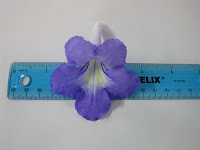
Photo "B-Strep cross BPBxIF Grouping" shows a grouping of some of the seedlings from this cross and all of the blooms in this photo are from different plants.
Shown in photos "D-Strep cross BPBxIF Seedling", Z1 and Z2, is probably my favorite so far. In person it is very brightly colored with a white throat and dark lines.
M. Wheeler
**I would like to welcome and thank M. Wheeler for sharing these photos and crosses with this blog!!!! How exciting to see what different traits and characteristics are passed along to the offspring.
*** NOTE click on the photo to make it full size for a closer view.


Thursday, December 04, 2008
Some Results???
 Here is the original plant that had perhaps the best of the flowers. There are six petals which is the interesting part of this strep.
But..... but it produced photo #2. A peloric flower with five very even petals with markings evenly spaced throughout the flower. I pollinated this particular flower.
The first baby that grew out of the cross was five petaled, but marked more like the original plant.
The second baby is also five petaled, but lighter in the throat. It's also a bit more fringed. So, we seem to be getting the five petal trait coming through. Is the six petal original more desirable, because it is the most different look considering most strep flowers? Is the perfectly even markings and five petals from the "peloric" flower the cool part? Although the babies aren't new and different, they are VERY interesting to see what is coming through with the self pollination! Comments???


Saturday, November 22, 2008
 This is our second baby!!! Perhaps to be named something like Fluffy Flamingo! Gott'a love the nice ruffles and the color. The petals are a pinkish red with darker veining, the throat is red with darker wine color lines. I should also add that this is a seed from a DIFFERENT pod than the photo just prior to this that is claimed as our first seedling.
This one is the second one that we got from the two pods that were put down in March of 08'. We perhaps could have had blooms faster, but this has been quite the experiment to see what does and what does not work when trying to get streptocarpus seeds to grow.
We would like to try several more crosses in the near future and see for ourselves which of the various traits are the most likely to be dominate. This just gets more and more fun as the babies are starting to produce their first flowers. Would anyone like to see (with photos) how to pollinate a streptocarpus flower?
Subscribe to:
Posts (Atom)